In the run up to the publication of forthcoming Alchemy
Press books we will be posting short interviews with the contributors.
Showing posts with label questions and answers. Show all posts
Showing posts with label questions and answers. Show all posts
Tuesday, August 13, 2013
Willie Meikle interviewed

Monday, June 10, 2013
Q&A: Pauline E Dungate

Tell us a little
about yourself, and what you like to write?
I spent all of my working life as a teacher but ended up as
the resident teacher at Birmingham Nature Centre with a classroom full of
exotic animals. I spend a lot of time reading, writing and reviewing when I am
not in the garden. I take my camera on exotic holidays looking for wildlife.
Last year it was Ecuador.
What inspired you to
write “One Man's Folly”?
Every year there is a Middle Earth Weekend at Sarehole Mill
in Hall Green, Birmingham. Because of the Tolkien connection, the local paper
often runs articles about his influences around this time. On the photo of
Perrot’s Tower, an octagonal building, I noticed that the corner stones of the
topmost floor looked very different from the rest of the brick built building.
That led to the question of what they were made of. What if it was a stone
circle in the sky. The story grew from there.
If the TARDIS could drop
you off to any one site in its heyday, where would you go?
It would probably have to be Hadrian’s Wall – either that or
British Camp, the hill fort on the Malvern Hills.
What appeals to you
most about ancient sites/landscapes?
The mystery. We know so little about them so there is much
that can be imagined and no-one can tell us we are wrong.
What do you have
coming out next?
I am working on a near future thriller set in Birmingham plus
a number of stories. I write reviews and poetry as Pauline Morgan and there are
plenty of my reviews around. The writers’ group I belong to has recently put
out a pamphlet called Grapeshot which
has three of my poems in it.
[Pauline E Dungate’s stories have appeared in anthologies such as Skin of the Soul, Narrow Houses, Swords Against the Millennium, Beneath the Ground, Merlin, Victorious Villains and Under the Rose. She has won prizes for poetry and has been a judge for the Arthur C Clarke Award. She reviews for SFCrowsnest and runs workshops covering all areas of creative writing. She lives in Birmingham with husband and fellow writer Chris Morgan.]
Thursday, April 25, 2013
Q&A: Kari Sperring
Today, KARI SPERRING answers questions set by the editors of
The Alchemy Press Book of Ancient
Wonders.
Tell us a little
about yourself, and what you like to write?
I'm a mediaeval
historian (specialising in Celts) by training and a writer by instinct – I started
writing aged seven and I haven't stopped since. I love swashbucklers, ancient
mysteries, things and people who are not what they seem, complex worlds and
intrigue, which get into everything I write. As does water; I can't account for
that, but most of what I write ends up with water as a key element.
If the TARDIS could
drop you off to any one site in its heyday, where would you go?
Oh, goodness, that's hard ... I don't know. Maybe the court
of Louis XIII or Louis XIV: I'd love to meet the real d'Artagnan, Athos,
Porthos and Aramis.
What appeals to you
most about ancient sites/landscapes?
That sense that the past is still there, immanent in every
stone and that we are all part of the flow of history.
What do you have
coming out next?
I have a sequel to The
Grass King's Concubine due from DAW, probably next year. It has no final
title as yet, but the working title is Death
and the Madwoman
[Kari Sperring grew up dreaming of joining the musketeers
and saving France, only to find they’d been disbanded in 1776. Disappointed,
she became a historian and as Kari Maund published six books and many articles
on Celtic and Viking history, plus one on the background to favourite novel, The Three Musketeers (with Phil Nanson).
She started writing fantasy in her teens, inspired by Tolkien, Dumas and
Mallory. She is the author of two novels, Living
with Ghosts (DAW 2009), which won the 2010 Sydney J Bounds Award, was
shortlisted for the William L Crawford Award and made the Tiptree Award
Honours’ List; and The Grass King’s
Concubine (DAW 2012).]
Saturday, April 20, 2013
Q&A: Lynn Cochrane
It’s LYNN M COCHRANE’s turn to answer questions posed by the
editors of Ancient Wonders.
Tell us a little
about yourself, and what you like to write?
Challenged to describe myself in three words, I answered,
"Orange headed barrel". Now you'll recognise me anywhere (oh,
and it has worked!). To quote my Scottish grandmother, I'm as old as my tongue
and a little older than my teeth, though I will admit to having both children
and grandchildren.
I prefer to write words. They often turn up as poems but
they also appear as stories, usually hovering in the intersection of science fiction,
fantasy and horror. Sometimes, the poems have tunes attached. Maybe they should
be called songs.
I'm a member of Yardley Baptist Church in Birmingham where I
serve as Newsletter Editor and as a member of both the Worship Team and the
Preaching Team – so perhaps you should add sermons to the list of things I
write!
What inspired you to
write “Ringfenced”?
A photo of a standing stone, somewhere in the north-east of
England, which had a ray of blue light firing straight up from its tip. Things
like that burn themselves into my memory.
If the TARDIS could
drop you off to any one site in its heyday, where would you go?
Ness of Brodgar. From there I could get to the Ring of
Brodgar and the Stones of Stenness, possibly also Maes Howe and Skara Brae, all
on Orkney. So many questions: Are they linked, other than by location? How are
they linked? Were they all in use at the same time? How were they used? Would I
be able to gain and give some answers?
What appeals to you
most about ancient sites/landscapes?
Pass the trowel ... if only! I'm fascinated by the remnants
in the ground (and anything still standing above ground) and by the puzzle of
what such things and buildings were used for. I'd love to take part in
archaeological explorations. Perhaps the big question is how someone from the
21st century would cope if they were dropped into the relevant point in time
and space.
What do you have
coming out next?
I'm always writing poems. It's almost as if they catch hold
of my hands and won't let go until they've been attached to paper or the
current electronic equivalent. I'm working on some short stories, a couple of
which may well end up being rather longer – novellas or even novels; who knows?
I also edit the showcase anthology for Cannon Hill Writers' Group, Salvo, and its new little sibling, Grapeshot.
[Lynn M Cochrane lives in the outskirts of Birmingham. She
has been writing most of her life and has produced three collections of poems. She
has had short stories published in convention publications and in Raw Edge, the West Midlands Arts
publication. She is a member of Cannon Hill Writers’ Group, leading writing
workshops from time to time.]
Friday, April 12, 2013
Q&A: Anne Nicholls
 Today, under the Ancient Wonders
spotlight is ANNE NICHOLLS.
Today, under the Ancient Wonders
spotlight is ANNE NICHOLLS.
Tell us a little about yourself,
and what you like to write?
I love a good story: thrills, adventures, heroism, the writing of
wrongs.
What inspired you to write “Dragonsbridge”?
I wrote “Dragonsbridge” after I got back from a great little fantasy
convention called Les Féeries du Bocage, held in a friendly village in rolling
French countryside an hour south of Paris. We were sat next to Pierre Dubois, a
famous TV presenter of all things to do with Arthurian romance, which was what
I did my thesis on. And of course we were quite close to the forest of
Brocéliande, which I looked up on Google Earth. Hmm, hidden valley, Celtic
deities, portals to Otherworlds, and just desserts (and I don't just mean those
fantastic lemon tarts you get in France!).
If the TARDIS could drop you off
to any one site in its heyday, where would you go?
If I could TARDIS into any specific place and time in history it would
have to be the Library at Alexandria in time to get the scrolls out before the
ravening religious nutters set fire to it. I so want to see the maps of
Atlantis, talk to the scholars and curators (after all, the TARDIS has a
translation and interpreting program) – and enjoy the weather after all this late,
blasted snow! I could free a couple of slaves who'd be grateful as well as good
cooks and go off and have wonderful lives of their own. And I'd just generally
enjoy ancient academia – before coming back to now with a small but tasteful
treasure trove.
What appeals to you most about
ancient sites/landscapes?
Hmm, ancient landscapes and sites. Well, all landscapes (except urban
ones) are ancient. It's the colour, the exoticism, the thought that so many
different peoples have lived their individual lives shaped by the great
cultural sweeps of history, climate and location, that's what appeals to me.
What about Florence in the time of Lorenzo? Wouldn't you just love to see the
procession he organised for his betrothal, him in his gold-bedecked armour, the
courtiers in their jewelled robes, the musicians and the artists before
Savanarola burned their pictures? The valleys of the Pueblo Indians when they
were still alive? Tahiti before cargo cults? The great greenwood that carpeted
the length and breadth of England as the last ice-age retreated? Charnwood
Forest when it fringed a tropic sea?
What do you have coming out
next?
I'm in the throes of finishing three short stories for Alchemy Press,
and a couple of novels – one historical and one a fantasy, so I'm keeping busy.
In fact, at times my life feels like a Heath Robinson contraption edited by
Escher. Luckily I'm enjoying the ride.
[Anne Nicholls, has had ten books published in SF
and the self-help fields. Her highly acclaimed novels Mindsail and The
Brooch of Azure Midnight appeared under the name of Anne Gay. For four
years she was the editor of LineOne's Science Fiction Zone, which had around
140,000 readers every month. She is currently working on a YA fantasy trilogy.
Anne also features in The Alchemy Press Book of Pulp Heroes.]
Tuesday, April 9, 2013
Q&A: Adrian Cole

Today, the spotlight falls on Ancient Wonders contributor ADRIAN COLE.
Tell us a little
about yourself, and what you like to write?
I'm a Devonian with Irish blood (County Cork) I live in
Solomon Kane country and I'm a retired Business Manager now writing full time.
I have a lovely wife, Judy, and two grown children, Sam and Katia; and the
other woman in my life is Bella, my feisty calico cat.
I write what I suppose could generally be termed imaginative
fiction, if such a term could adequately cover SF, fantasy, horror, pulp, with
a few crossbred bits. I have had over 20 novels published, and many short stories,
since the mid-seventies. I enjoy writing old fashioned pulp stories but equally
enjoy writing modern SF.
What inspired you to
write “The Sound of Distant Gunfire”?
One of the ways I try to keep fit is by cycling and in North
Devon we are blessed with some marvellous trackways, including an old railway line
converted to a cycle path for nearly 20 miles. I've been up and down it
numerous times and the countryside and unique atmosphere gave me the idea for
the story, although I don't actually find the cycle path spooky – it appeals to
the elemental in me. (Or perhaps that should be, the mental in me).
If the TARDIS could
drop you off to any one site in its heyday, where would you go?
Machu Picchu, up in the Andes. I'd want to be disguised as a
native, though, otherwise I daresay I'd be pegged out and sacrificed to the
sun, or worse. I've never been there, but one day...
What appeals to you
most about ancient sites/landscapes?
Like many people, I suppose, I relate to them in some kind
of atavistic way. I am an outdoor person (but also, by contrast, bookish and
movie-ish) and love the elements – I lived on the edge of Dartmoor as a kid and
as a youngster I grew up around the Cornish landscape (mines and beaches); and
I now spend a big chunk of the year in the sea (I go home for tea, of course). Much
as I appreciate modern technology, I still feel moved by the ancient past. I
think it is because people were closer to the earth and the elements in those
days.
What do you have
coming out next?
My next novel is due out in 2014 and is a science fiction
book, The Shadow Academy. It is set
in an alternative Britain, the action moving between Dumnonia (Devon) and
Londonborough. It's about a corrupt Authority and how it abuses power, a common
theme in all my stuff!
There are some short stories due as well, “Nightmare on Mad
Gull Island”, a booklet from Spectre Press, and “You Don't Want to Know”, which
will be in Stephen Jones' third Innsmouth collection from Fedogan and Bremer, Weirder Shadows Over Innsmouth – both of
these are Nick Nightmare stories and there are more of his stories in the works.
He's got a strong grip on my PC at the moment. And there are other various
projects in hand, large and small. Watch this space!
[Adrian Cole is the author of 25 novels, beginning with The Dream Lords in the 1970s, through The Omaran Saga and the Star Requiem to the Voidal Saga in 2011. He is also the author of numerous fantasy and
horror short stories, having been published in Year’s Best Fantasy and Year’s
Best Fantasy and Horror. Forthcoming from Edge Books is the novel The Shadow Academy; he has a short story
in The Worlds of Cthulhu anthology due
soon from Fedogan and Bremer; and he also has a story in The Alchemy Press Book of Pulp Heroes (sister volume to The Alchemy Press Book of Ancient Wonders).]
Friday, April 5, 2013
Q&A: Shannon Connor Winward

Under the spotlight today: SHANNON CONNOR WINWARD
Tell us a little about yourself, and what
you like to write?
I’m an American
author and poet. Most of what I create is speculative – some sci-fi, fantasy,
and what’s been called “mythpunk” – though I write a little bit of everything. On
my blog I talk about real life: the writing process, the emotional ups and
downs. I chronicle my experiences raising a child with special needs, because I
feel there’s a lack of information and empathy for families who have to go
through this, and it’s my way of contributing to a larger conversation. I like
to write about what touches me, what fascinates me. A lot of my stories deal
with death and madness, but not in a macabre sense. I like to explore
liminalities.
What inspired you to write Passage?
I minored in
anthropology as an undergrad, with a special interest in the Celts of Britain
and Ireland. I was writing a thesis on Celtic death rituals, which is largely
speculative due to a scarcity of archaeological evidence. I came across a
discussion of how the Celts may have used the monoliths as a means of
connecting themselves psychologically to the landscape, since they had
emigrated there, and places like Newgrange and Stonehenge predated their
culture considerably. I became so distracted with the idea that I wrote
“Passage” instead of what I was meant to be working on. I scribbled it in the
middle of my research notes.
If the TARDIS could drop you off to any one
site in its heyday, where would you go?
I’d love to visit
Great Britain in the Iron Age – though, to be honest, if the Doctor came to get
me, I wouldn’t be picky.
What appeals to you most about ancient
sites/landscapes?
I feel a closer
kinship to ancient religions than to modern ones, at least in a spiritual
sense. Our ancestors were more intimately tied to nature and her cycles, and
that is reflected in their sacred sites.
What do you have coming out next?
I have poems due
out in various magazines, all TBA, and I’ve been invited to participate in some
local fiction anthologies. Right now I’m working on a sci-fi story inspired by
Egyptian mythology and Edgar Rice Burroughs, and a modern-day fairy tale about a
wicked librarian. I’m also working on my second novel, an urban fantasy, and my
first poetry collection. I publish updates and links to my work on my blog.
[Shannon Connor Winward's writing has appeared in many
venues including: Pedestal Magazine, Flash Fiction
Online, Strange Horizons, Illumen, This Modern Writer [Pank Magazine], Hip Mama
Zine and the anthologies Twisted Fairy
Tales: Volume Two, Jack-o'-Spec: Tales of
Halloween and Fantasy and Spectacular:
Fantasy Favorites. Her poem "All Souls' Day" is nominated
for a 2012 Rhysling Award.]
Monday, April 1, 2013
Q&A: James Brogden

Today under the spotlight: JAMES BROGDEN
Tell us a little
about yourself, and what you like to write?
I'm based in the Midlands; grew up in Australia and
instantaneously fell in love with the UK as a teenager because of the dense
layering of history, myth and legend that exists underfoot everywhere you go. I
like to write urban fantasy – which is to say, horror without the clichés.
Fantastical elements intruding upon everyday lives.
What inspired you to
write “If Street”?
Robert Holdstock, mostly. I love the Mythago Wood books, which are very firmly rooted in the
countryside, and have always been curious about what would happen in an urban
setting, with all those ancient track ways buried under tarmac and concrete.
I've also been researching Sutton Park for another novel, so the place was
already stuck in my head.
If the TARDIS could
drop you off to any one site in its heyday, where would you go?
I'd go to Hadrian's Wall. Not only to see and appreciate the
engineering, but also to get that sense that you are really on the edge of the
world, that beyond this point there is no law or civilisation as you understand
it. When my family moved to England we lived in the Borders, north of the wall,
in the kind of place you got posted if you'd really annoyed someone back in
Rome. I'd like to talk to them and ask them what that was like – but they'd
probably tell me that they're just soldiers doing their jobs and to sod off.
What appeals to you
most about ancient sites/landscapes?
That sense of common humanity which goes beyond time and
place. We went on a family trip to Hadrian's Wall one Easter and saw that there
was monument to the fallen soldiers of the legions who had been posted there,
and it was exactly the same kind of monument you see today in small country
villages, and it struck me how similar their feelings and experiences must have
been to those of the men and women who are currently posted in, say,
Afghanistan. I love old Iron Age hill forts for the same reason. It's
mind-blowing to stand in a hut circle three thousand years old and know that here was the place where they cooked
their meals, here was the door where
a child probably looked out for his friends first thing in the morning. That
kind of thing.
What do you have
coming out next?
Couple of things: a story called “The Remover of Obstacles”
in Anachron Press' anthology Urban Occult,
and a second novel, Tourmaline
published by Snowbooks, out in July.
[James Brogden was born in Manchester, grew up in Australia,
and now lives with his wife and two daughters in Bromsgrove, Worcestershire,
where he teaches English. His short stories have appeared in the Big Issue, the British Fantasy Society’s
Dark Horizons, Gears Levers Volume One, and his first novel, The Narrows, has just been published by Snowbooks. When he's not
writing, or trying to teach children how to, he gets out into the mountains
exploring the remains of Britain's prehistoric past and hunting for standing
stones. Fortunately they don't run very fast. ]
Friday, March 29, 2013
Q&A: Peter Crowther

Today under the spotlight: PETER CROWTHER, whose story "Gandalph Cohen and the Land at the End of the Working Day" appears in The Alchemy Press Book of Ancient Wonders.
Tell us a little
about yourself, and what you like to write?
My real weakness in reading is horror and ghost stories and
the kind of SF stories that are filled with awe and wonder ... such as
Bradbury, for example. Stephen King is the main man for me simply because of
his characterisation. Sure, the stories are good -- well, there's an occasional
so-so one but, with the sheer quality of his writing, you can pretty much
forgive him anything -- but it's the depth of detail in his backgrounds as well
as his foregrounds that puts the guy above anyone else writing today. And just
to set my stall fully out, I've read several thousand books ... with faves
being the late Robert B Parker, early Updike, Richard Ford, all the classic SF
and horror books (and I do mean all),
stuff like Wodehouse, early pulps (Prather, Thompson, Goodis and so on),
Fitzgerald and on and on and on. What do I like to write? Pretty much the same
as what I like to read. I wrote a story called “Tomorrow Eyes” simply because I
really wanted to write something Runyonesque, a story called “The Incredible
Multiplicity of PhaedraLament” because I wanted to emulate Clarke's White Hart, and so on. So I guess it's
the attraction of speaking in a specific voice that attracts me.
What inspired you to
write “Gandalph Cohen and the Land at the End of the Working Day”?
I loved Spider Robinson's tales set in Callaghan's Crosstime
Saloon and I've long fancied having my own barroom for the telling of tall
tales. “Gandalph Cohen” was the first of them; there are three more, each of
them following the same formula ... Jack Fedogan playing jazz on the bar's PA
system, the regulars sitting around a table chewing the fat or telling jokes,
and a stranger coming into the bar with a “story” to tell or re-enact. There's
a nice story concerning these stories and Dave Brubeck ... but I don't want to
bore you so I'll tell it another time. Catch me at a convention and ask me
about it sometime.
If the TARDIS could
drop you off to any one site in its heyday, where would you go?
I've always wanted to go back to the late 1950s and go knock
on the door of our old house (I was born in 1949, 4 July). I love the idea of
my mom or dad opening the door and asking if they could help me while, behind
them, this wide-eyed nosy kid stands watching me from behind them, an open book
or comic hanging from his hand. And I'd like to go to a US city of that period,
with a wad of dollars in my pocket so that I could buy copies of great comic books
for just a dime apiece. I wrote a story along these lines called “The Doorway
in Stephenson's Store” -- if you read it then please do bear in mind that it
was written and published some five years before Stephen King unveiled 11.22.63.
What appeals to you
most about ancient sites/landscapes?
Just seeing the way things used to be. Rightly or wrongly, I
am fascinated by (and attracted to) the past. Can't get enough of it.
What do you have
coming out next?
Just a few stories here and there, and then my long-threatened
mainstream novel Thanksgiving ...
currently standing at 110,000 words and waiting for the final spurt…
[Peter Crowther is the recipient of numerous awards for
writing, editing, and as publisher of the hugely successful PS Publishing (which
includes Stanza Press, the Drugstore Indian mass market paperbacks, PS Visual
Entertainment and PS Art Books). As well as being widely translated, his short
stories have been adapted for TV on both sides of the Atlantic, and collected
in The Longest Single Note, Lonesome
Roads, Songs of Leaving, Cold Comforts, The Spaces Between the Lines, The Land
at the End of the Working Day and the upcoming Jewels in the Dust. He is the co-author (with James Lovegrove) of Escardy Gap and The Hand That Feeds, and has also written the Forever Twilight SF/horror cycle. He lives and works with his wife
and business partner Nicky Crowther on England’s Yorkshire coast.]
Photo (c) Peter Coleborn
Saturday, March 23, 2013
Q&A: Bryn Fortey

Today under the spotlight is BRYN FORTEY, answering
questions set by the editors of The
Alchemy Press Book of Ancient Wonders.
Tell us a little
about yourself, and what you like to write?
OAP. Widower. GSOH. Friendship, maybe more – oh no, sorry,
that's the Two's Company
ad I'm trying to put together.
Writing-wise: it used to be short stories, then I wrote a
lot of poetry, now I'm back to short stories. Sort of horror, SF, weird,
oddball. I like crossovers and work that's difficult to categorize.
What inspired you to
write “Ithica or Bust”?
David A Sutton told me about the Ancient Wonder anthology only weeks before the deadline. Being so
long out of the loop I had no real idea of what was required but wanted to have
a go, so updated a bit of Greek mythology into science fiction space
opera, throwing in as many references as I could squeeze onto the page. It
was very untypical of my more usual output but I had great fun putting it
together.
If the TARDIS could
drop you off to any one site in its heyday, where would you go?
I would get the TARDIS to drop me off at Cheltenham Race
Course one day next week so I could jot down all the winners and come back to
make a fortune from the bookies.
What appeals to you
most about ancient sites/landscapes?
My problem here is that at my age I remember most ancient
sites and landscapes when they were new.
What do you have
coming out next?
Two stories in Shadow Publishing's reprint anthology Horror! Under the Tombstone, and two
stories accepted by the American audio magazine Tales to Terrify, but I have not been told yet when they are due to
be used.
[Bryn Fortey appeared in various anthologies during the
1970s, including: New Writings in Horror
& the Supernatural and New
Writings in SF. He was also published in various Fontana anthologies edited
by Mary Danby. Bryn’s beat-styled poetry magazine Outlaw was Best UK Small Press Magazine of 2004 in the Purple Patch
Awards. In the same year he won the Undercurrent Aber Valley Short Story
Competition with “The Dying Game”. In 2009 his “A Taxi Driver on Mars” was
first in the Data Dump Awards for SF poetry in the UK. Bryn hales from South
Wales.]
Sunday, March 17, 2013
Q&A: Aliette de Bodard
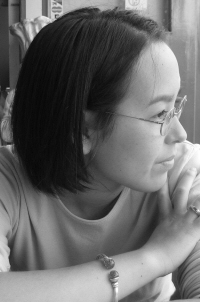
Tell us a little about yourself and what you like to write?
I'm a writer, engineer and over-enthusiastic cook who loves to write character-driven stories in strange and familiar worlds (and to put fish sauce in everything, including stories!). I've written SF, historical fantasy and creepy horror – bit of an eclectic person, really.
What inspired you to write “Ys”?
“Ys” is inspired by a very famous Briton legend I read when I was younger; the image of a sunken city beneath the waves has always remained with me, as well as the idea that on clear days, you can hear the bells of the submerged churches ringing through the streets. Dahut/Ahes, the princess who doomed Ys, was thrown from her father's horse after he discovered she had been the one to open the gates to the sea; and from there on it wasn't much of a stretch to imagine both city and princess would still be around in modern-day France.
If the TARDIS could drop you off to any one site in its heyday, where would you go?
Hmm, it's a tie, but I think I'd pick either Hue or My Son – they're wonderful Vietnamese sites that you can only visit a small part of, due to all the bombs that got dropped on them during the Vietnamese/American war. I've always wondered what it would be like to walk there before destruction struck.
What appeals to you most about ancient sites/landscapes?
The sense of history; and wondering how people might have lived, and how different they might have been. Also, they're usually very beautiful!
What do you have coming out next?
I have a limited-edition novella, On a Red Station, Drifting, which is out from Immersion Press (and nominated for a Nebula at the moment); and a couple stories forthcoming in various markets. I'm also attempting to wrestle an urban fantasy set in Paris into proper shape.
[Aliette de Bodard lives and writes in Paris, France, in a flat with more computers than warm bodies, and two Lovecraftian plants in the process of taking over the living room, one tentacle at a time. In her spare time, she writes speculative fiction: her Aztec-noir fantasy Obsidian and Blood is published by Angry Robot, and she has been a finalist for the Hugo and Nebula Awards, and has won the British Science Fiction Association Award.]
Monday, March 4, 2013
Q&A: Misha Herwin

Today, Ancient Wonders' contributor MISHA HERWIN answers searching questions.
Tell us a little
about yourself, and what you like to write?
I am compulsive writer who’s been writing ever since I could
hold a pen. Rather to my surprise I’ve ended up living in Stoke with an ever
patient husband and a moaning cat, who is convinced we don’t feed her enough. I write books and short stories for adults and
kids and my work usually has a supernatural and fantasy element to it.
What inspired you to
write “The Satan Stones”?
“The Satan Stones” was inspired by the Devil’s Ring and
Finger, a pair of Neolithic standing stones near where I used to live in
Shropshire. They have very powerful hold on my imagination and also appear in
my latest novel, House of Shadows.
If the TARDIS could
drop you off to any one site in its heyday, where would you go?
If I could leap into the TARDIS I’d definitely find my way
back to the Devil’s Ring and Finger because I would love to know what really
went on there.
What appeals to you
most about ancient sites/landscapes?
The appeal of ancient sites and landscapes is their
atmosphere of mystery and magic.
What do you have
coming out next?
At the moment House of
Shadows is with my agent and I’m working on a YA novel about a dystopian
future where wars will be fought over water rather than oil. Juggler of Shapes, my second book in the
Dragonfire Trilogy, is now out as an
e book.
[Misha Herwin has been writing for many years. At twelve she
wrote and staged her first play in a theatre made from a cardboard box. Since
then her plays for teenagers have been performed in schools by the Stagefright
Theatre Company and at the Canadian High Commission in Jamaica. She has
published the Dragonfire Trilogy for
kids and her stories can be found in a number of anthologies and magazines
including Hens, Bitch Lit and Ghostly Reflections. “The Dragon Who
Came to School” was broadcast by ABC Tales.]
Thursday, February 28, 2013
Q&A: John Howard

The editors of The Alchemy
Press Book of Ancient Wonders asked their contributors some searching
questions. Now it’s the turn of JOHN HOWARD.
Tell us a little about yourself,
and what you like to write?
I like to write about things
which interest me – often to do with forgotten or alternate histories, obscure
places, ambiguous people.
What inspired you to write “Time
and the City”?
The title of the anthology!
Something ancient, something wonderful. I love SF pulp magazine artwork from
the 1920s and ’30s: those cities and buildings, wonderful machines and
spaceships by the likes of Frank R Paul and Leo Morey. So a story about an
incredibly ancient city full of wonders came into my mind…
If the TARDIS could drop you off
to any one site in its heyday, where would you go?
Rome.
What appeals to you most about ancient
sites/landscapes?
The sense of standing on the edge
of the abyss of time.
What do you have coming out next?
A couple of stories in
anthologies, plus a collection from Swan River Press called Written by
Daylight.
[John Howard was born in London.
He is the author of the collection The Silver Voices and the novella The Defeat
of Grief. His short fiction has appeared in several anthologies, including
Beneath the Ground, Never Again, and The Touch of the Sea. John has
collaborated with Mark Valentine on a number of short stories, six of which
featured Valentine’s long-running occult detective The Connoisseur. These tales
have been reprinted in The Collected Connoisseur. Most recent to appear is
Secret Europe, (written with Mark Valentine) to which John contributed ten of
the twenty-five stories, set in a variety of real and fictional European
locations.]
Photo (c) Peter Coleborn
Saturday, February 23, 2013
Q&A: William Meikle
The editors of The
Alchemy Press Book of Ancient Wonders asked their contributors some
searching questions. Next up is WILLIAM MEIKLE.


Tell us a little about
yourself, and what you like to write?
I'm a Scottish writer. Around 1991 I started to submit
stories to the UK small press mags. It's been a slow but steady progression
from there. I now have over twenty five professional short story sales and have
fifteen novels published in genre presses.
I've been asked many times why I write what I do. I choose
to write mainly at the pulpy end of the market, populating my stories with
monsters, myths, men who like a drink and a smoke, and more monsters. People
who like this sort of thing like it.
I write to escape.
I grew up on a West of Scotland council estate and I spent a
lot of time alone or at my grandparent's house.
My granddad was housebound, and a voracious reader. I got
the habit from him, and through him I discovered the Pan Books of Horror and
Lovecraft, but I also discovered westerns, science fiction, war novels and the
likes of Mickey Spillane, Ed McBain, Alistair MacLean, Dennis Wheatley, Nigel
Tranter, Arthur C Clarke and Isaac Asimov. When you mix all that together with
DC Comics, Tarzan, Gerry Anderson and Dr Who then, later on, Hammer and
Universal movies on the BBC, you can see how the pulp became embedded in my
psyche.
I think you have to have grown up with pulp to get it. A lot
of writers have been told that pulp equals bad plotting and that you must have
deep psychological insight in your work for it to be valid. They've also been
told that pulp equals bad writing, and they believe it. Whereas I remember the
joy I got from early Moorcock, from Spillane and further back, A Merritt and H
Rider Haggard. I'd love to have a chance to write a Tarzan, John Carter, Allan
Quartermain, Mike Hammer or Conan novel, whereas a lot of writers I know would
sniff and turn their noses up at the very thought of it.
I write to escape. I haven't managed it yet, but I'm working on it
What inspired you to
write “The Cauldron of Camulos”?
I've tried my hand at several works of fantasy over the
years, and they almost always come out the same way – pulpy, with swords,
sorcery, monsters and bloody battles to the fore. It's the way I roll.
I may start with good intentions, of writing high fantasy
with political intrigue and courtly goings on but, as in the Watchers series, Berserker and the Augustus
Seton stories, my inner barbarian muscles to the fore, says Bugger this for a lark, and starts hacking.
The blame for my enthusiasm can be laid squarely at several
doors. There's Conan, of course, and Elric, Corum, Hawkmoon and the whole
pantheon of Eternal Champions; there's Fafhrd and the Gray Mouser, Solomon
Kane, Jon Shannow, the princes of Amber and the shades of a thousand more from
the likes of Poul Anderson, A Merritt, Edgar Rice Burroughs, H Rider Haggard, Karl
Edward Wagner and many others
So, there's that, and a long standing fascination with
Arthur going way back to my childhood and reading The Sword in the Stone, Elidor and a big book of medieval romances
with exciting colourful prints of knights and damsels and dragons.
In "The Cauldron" I wanted to strip away the
medieval and go back to the Celtic and Saxon versions of the legends, although
I suspect Arthur and the Grail as archetypes go back even further than that.
If the TARDIS could
drop you off to any one site in its heyday, where would you go?
I'd love to see Orkney, during the mound-building, menhirs-raising
years. I'd love to see Maes Howe and the Ring of Brodgar going up and discover
why they were built as they were. Or Carnac in Brittany. I'd love to revisit it
while it was getting put up.
What appeals to you
most about ancient sites/landscapes?
I have a deep love of old places, in particular menhirs and
stone circles, and I’ve spent quite a lot of time travelling the UK and Europe
just to visit archaeological remains. I also love what is widely known as “weird
shit”. I’ve spent far too much time surfing and reading Fortean, paranormal and
cryptozoological websites. The cryptozoological stuff especially fascinates me,
and provides a direct stimulus for a lot of my fiction.
But there’s just something about the misty landscapes and
old places that speaks straight to my soul. Bloody Celts … we get all
sentimental at the least wee thing.
What do you have
coming out next?
Next up is a weird Sherlock Holmes collection, The Quality of Mercy and Other Stories from
a new imprint, Dark Renaissance. It's in deluxe limited edition hardcover and
trade paperback editions, with a dozen illustrations by Wayne Miller who has
previously done a lot of work on my covers for Dark Regions Press.
"When I first set out to document the casebook of my
good friend Sherlock Holmes, there were some cases I approached with a certain
degree of trepidation. Holmes has a public face as a man of strict rationality,
a stickler for method and observation. But Holmes himself has always been open
to more extreme possibilities."
In these pages you'll find, among other things, a Jade
pendant that bestows great power, a fiddle that holds the key to an ancient
secret, a lost overcoat that wants to return to its owner, and an encounter
with an old foe that imperils the whole of Great Britain. All of them are cases
that Holmes and Watson must solve, even if they have to open themselves to
extreme possibilities to do so.
[William Meikle is a Scottish writer with fifteen novels
published and over 250 short story credits in thirteen countries. His work has
appeared in a number of anthologies; recent short stories were sold to Nature Futures, Penumbra and Daily Science Fiction. He now lives in a
remote corner of Newfoundland, Canada, with icebergs, whales and bald eagles
for company. In the winters he gets warm vicariously through the lives of
others in cyberspace.]
Friday, February 22, 2013
Q&A: Adrian Tchaikovsky

Tell us a little about yourself, and what you like to write?
I’m a writer of epic fantasy, with eight books out in my series Shadows of the Apt and the ninth coming out this August. I’m also a lawyer (civil litigation) and my interests include LARP, RPGs (games, not grenades), sword techniques and zoology, but I had been working towards becoming a published author for a long time.
My current series is set to run to ten books, charting a conflict between the insect-kinden that takes them into their equivalent of the 20th century, and a world war. I’m currently working on a number of future projects in different settings.
What inspired you to write “Bones”?
“Bones” is set in the same world as the Shadows of the Apt series, and draws on a chance reference a character makes in The Sea Watch to an archaeological site where the deep past of the insect-kinden’s world appears to have been uncovered. This sparked a lot of speculation amongst readers, so I decided that the site deserved a story of its own. When the call for the Ancient Wonders anthology came along it seemed the perfect opportunity to write it.
If the TARDIS could drop you off to any one site in its heyday, where would you go?
With deep apologies to the whole of human history, I think that I would need to tool up and go see the truth behind the fossils. The choice isn’t Ancient Rome or da Vinci’s studio, for me, it’s Cretaceous or Carboniferous, or scuba diving through the Burgess Shale fauna.
What appeals to you most about ancient sites/landscapes?
There is nothing more evocative than an ancient landscape, civilisation or relic that still retains its mystery. All too often that turns out to be something of a false promise, but when confronted by something like the Antikythera mechanism, or the as-yet unopened tomb of Qin Shi Huang, it’s a window onto a past that remains as mysterious and elusive as myth.
What do you have coming out next?
The last two volumes of Shadows of the Apt should be out this year and next, after which I have a stand-alone fantasy, Guns of the Dawn, which takes place in a sort of alternate 1800-style of setting, concerning a bitter war between two formerly close nations. My personal tagline is “Jane Austen meets Bernard Cornwell by way of Ursula le Guin.”
[Adrian Tchaikovsky was born in Lincolnshire, studied and trained in Reading and now lives in Leeds. He is known for the Shadows of the Apt fantasy series starting with Empire in Black and Gold, and currently up to book eight, The Air War. His hobbies include stage-fighting, and tabletop, live and online role-playing.]
Photo (c) Peter Coleborn
I’m a writer of epic fantasy, with eight books out in my series Shadows of the Apt and the ninth coming out this August. I’m also a lawyer (civil litigation) and my interests include LARP, RPGs (games, not grenades), sword techniques and zoology, but I had been working towards becoming a published author for a long time.
My current series is set to run to ten books, charting a conflict between the insect-kinden that takes them into their equivalent of the 20th century, and a world war. I’m currently working on a number of future projects in different settings.
What inspired you to write “Bones”?
“Bones” is set in the same world as the Shadows of the Apt series, and draws on a chance reference a character makes in The Sea Watch to an archaeological site where the deep past of the insect-kinden’s world appears to have been uncovered. This sparked a lot of speculation amongst readers, so I decided that the site deserved a story of its own. When the call for the Ancient Wonders anthology came along it seemed the perfect opportunity to write it.
If the TARDIS could drop you off to any one site in its heyday, where would you go?
With deep apologies to the whole of human history, I think that I would need to tool up and go see the truth behind the fossils. The choice isn’t Ancient Rome or da Vinci’s studio, for me, it’s Cretaceous or Carboniferous, or scuba diving through the Burgess Shale fauna.
What appeals to you most about ancient sites/landscapes?
There is nothing more evocative than an ancient landscape, civilisation or relic that still retains its mystery. All too often that turns out to be something of a false promise, but when confronted by something like the Antikythera mechanism, or the as-yet unopened tomb of Qin Shi Huang, it’s a window onto a past that remains as mysterious and elusive as myth.
What do you have coming out next?
The last two volumes of Shadows of the Apt should be out this year and next, after which I have a stand-alone fantasy, Guns of the Dawn, which takes place in a sort of alternate 1800-style of setting, concerning a bitter war between two formerly close nations. My personal tagline is “Jane Austen meets Bernard Cornwell by way of Ursula le Guin.”
[Adrian Tchaikovsky was born in Lincolnshire, studied and trained in Reading and now lives in Leeds. He is known for the Shadows of the Apt fantasy series starting with Empire in Black and Gold, and currently up to book eight, The Air War. His hobbies include stage-fighting, and tabletop, live and online role-playing.]
Photo (c) Peter Coleborn
Subscribe to:
Posts (Atom)